
The Book
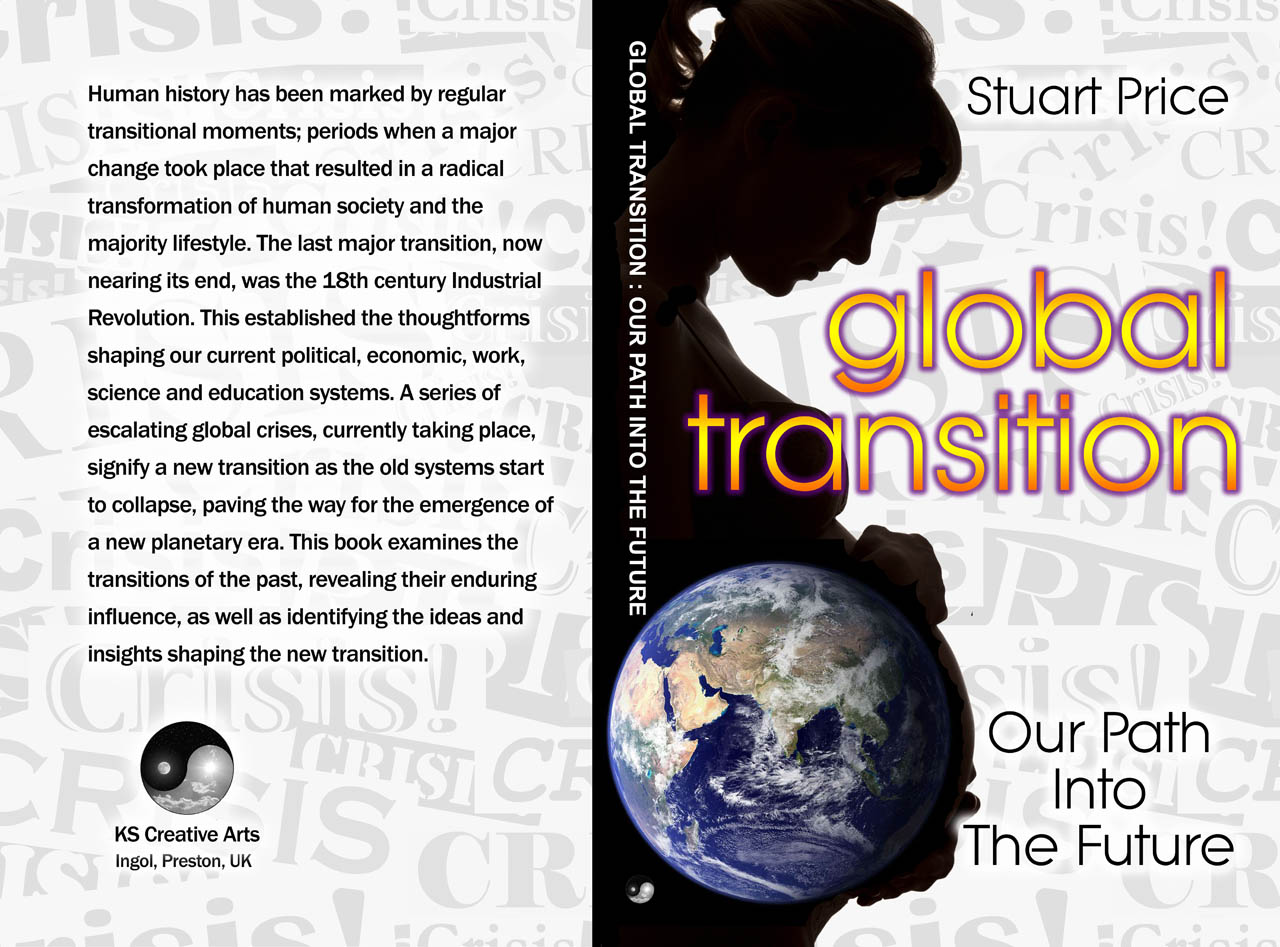
181 pages, 34,000 words
Buy from Amazon UK, £10.99, postage free, or Amazon worldwide.
Contents
Chapter 1. Transitions Within Human History
A series of major transitions in human history and their impact on the modern world are discussed. The use of fire opened the way for technology to be developed. The development of language led to a capacity for self-centred abstract thinking. The birth of agriculture displaced a realisation of nature as a gift to be honoured, towards seeing nature as a resource to be exploited. Civilisation and City Life created the blueprint for how society is structured today. European colonisation of the world created a sense that European society is superior to other cultures. The Industrial Revolution introduced us to our current forms of work, politics and economics. An understanding that the world we have created is no longer sustainable forces us to recognise the need for a new transition.
Chapter 2. The Industrial Revolution
Beginning in the 1700s, this transition has proceeded in stages; covering technological, legal, scientific, economic and social developments. Underpinning this entire period is a series of core ideas in the fields of Economics, Politics and Science. The ideas of Enlightenment thinkers Adam Smith (1723-1790), John Locke (1632-1704) and Isaac Newton (1642-1727) are examined, showing how they have shaped the type of society we have today and where they come into conflict with the modern world.
Chapter 3. Economics and Finance
Looking at the historical development of the ideas of an Economy and a Money Supply, the founding of the Bank of England, the influence of Adam Smith, the Great Depression of the 1930s and the development of Neoliberalism. The nature of modern currencies developed near the end of the 20th century, digital information, creates a unique opportunity for radical economic system change.
Chapter 4. Politics and Governance
Comparison between the nature of democracy, as invented & practiced by the Ancient Greeks, and what it has become since the Industrial Revolution. Briefly looking at some major political theorists (Plato, Larry Diamond) and modern innovations for "system change" in our governance structures. The dual movement towards Localism (an enhanced role for local neighbourhoods and residents in the political process) and Globalism/world government is discussed.
Chapter 5. Science: Entry into a New Reality
The new 21st century understanding of the nature of things, as revealed by Albert Einstein and the Quantum theorists. The science of "consciousness" breaks down the historical conflicts between Science & Religion.
Chapter 6. The 20th Century Enlightenment
As well as Science, this century saw significant developments in our understanding of many issues that have become part of mainstream collective awareness and that comprise the foundational ideas for the new transition. Swami Vivekenanda introduced to the west the ideas of vedantic spirituality, to further illuminate the truths of the 3 world religions of The Book. Sigmund Freud and Carl Jung contributed to a major insight into the nature of the human mind. Emmeline Pankhurst significantly contributed to gender equality by winning for women the democratic vote. Rachel Carson was the leading figure in the development of environmental awareness. Plus many others. The cultural ideas of the 1960s get a special mention.
Chapter 7. Mother Earth: Jewel of the Cosmos
What are the characteristics of the emerging sustainable world society, where is the change coming from and what does it involve? The nature of "crisis". Human society re-imagined through an understanding of ecological principles in nature. Spiritual renewal, the "story in the mind" and initiation into holistic consciousness. How the largest movement in the world is coming into being.
181 pages, 34,000 words
Buy from Amazon UK, £10.99, postage free, or Amazon worldwide.
Free Download of Book
A free PDF version of the book is available HERE